Effective Plantar Fasciitis treatment in Kingston & Surbiton is provided by Hugo Firth, registered Osteopath. If you have heel or foot pain that has been getting worse over the last few months then the following information may help.
What is Plantar Fasciitis?
It is inflammation on the sole and heel of your foot, specifically the fascia. It can give you very painful specific areas on your heel and or often around the arch of your foot. Typically the first few steps in the morning can be like walking on glass.
Causes of Plantar Fasciitis
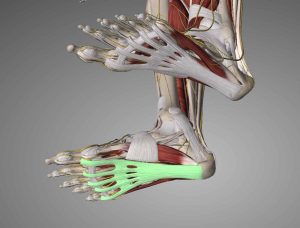
The pain and inflammation is due to micro tears that have occurred in the fascia highlighted in green.
Footwear that is worn at the heel or doesn’t provide adequate support can often be triggers. Research also shows that biomechanics of the foot, knee and hip all play a role in causing the fascia to be overworked. Tight calf muscles are often blamed but stretching calf muscles alone does not alleviate the problem.
It’s useful to consider causes from two perspectives; Forces acting on the foot from the ground up and forces acting on the foot from above.
That is to say you need to consider what role your footwear is playing managing the forces as you step on the ground as well as what your hip and leg muscles are doing to influence the movement of the foot. So any effective treatment should consider both.
Plantar Fasciitis Treatment
Two approaches
If you have been managing with your foot pain for less than a month then a combination of soft tissue massage to foot, heel and calf muscles, addressing any footwear issues and strengthening and mobility exercises for foot, leg and hip muscles and joints can often help address this.
However if you have been ‘managing’ the pain for a longer period then more often than not the healing process in the fascia has stalled and a kick start to the healing process is needed.
Shockwave Therapy
Before Shockwave Therapy, treatment would involve deep tissue massage on the painful areas and muscle release work into calf muscles along with advice on footwear and insoles, exercises for improved foot mobility and muscle strengthening for legs and hips. Within 8-10 weeks patients would note a slow improvement. The problem being the deep tissue massage would struggle to affect the deep lying fascia sitting beneath thick fat pads on the heel.
With Shockwave therapy the clinician can vary the depth of treatment by increasing or decreasing the pressure that creates the sound wave and so much more effectively treat the fascia and kick start the heeling process in those tissues.
A shockwave treatment once every 5-7 days over a period of 4-6 weeks normally provides significant improvements when accompanied with changes to footwear and exercises.
However it is worth noting that patients that are over 65 yrs of age it can take longer as the older we are the slower we heal.
If you would like to find out more about how you can get some help or just want to ask a few more questions about the treatment please get in touch